
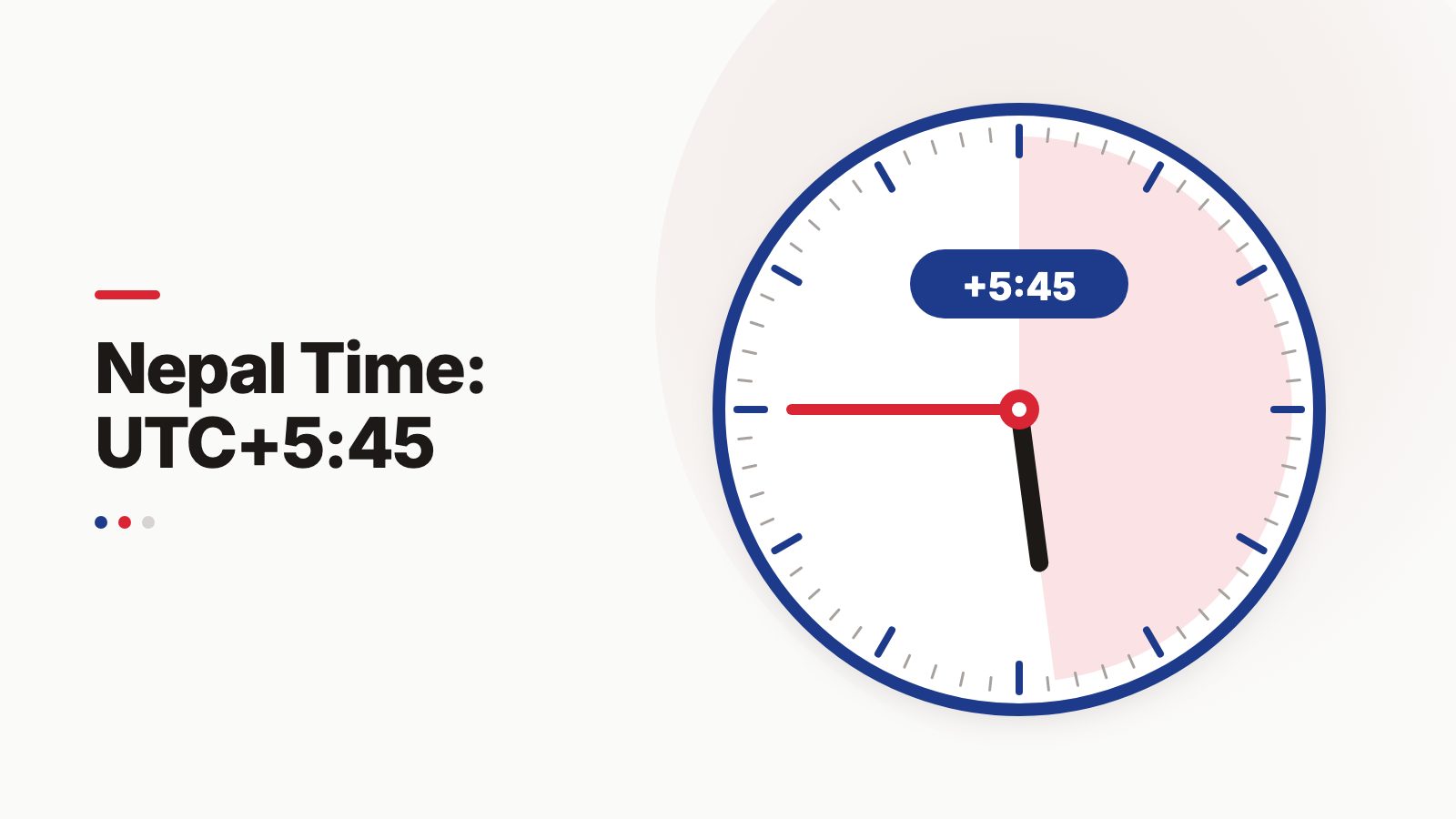
Nepal time is UTC+5:45: five hours and forty-five minutes ahead of Coordinated Universal Time, all year round. Nepal is 15 minutes ahead of India, and it does not use daylight saving time. Very few places use a 45-minute offset. Nepal and the Chatham Islands of New Zealand are the main ones. Nepal has used UTC+5:45 officially since 1986.
Where the 45 minutes comes from
In principle, time zones follow the Sun. Local noon, when the Sun is highest in the sky, moves one hour for every 15 degrees of longitude. Nepal's reference meridian is 86.25 degrees east, close to the longitude of Gaurishankar, a Himalayan peak east of Kathmandu. 86.25 divided by 15 is 5.75 hours, which is five hours and forty-five minutes. Nepal set its clock to the solar time of its own meridian instead of rounding to a neighbour's clock.
The change became official in 1986. Before that, Nepal used UTC+5:30, the same as India. Moving the clock 15 minutes ahead matched it to Nepal's own longitude and gave Nepal a standard time separate from India's.
Nepal time vs India time
Nepal time is always 15 minutes ahead of India. When you cross the border at Birgunj or Bhairahawa, your phone clock changes by 15 minutes. To get Indian time, subtract 15 minutes from Nepal time. If you are catching a train or bus on the Indian side, check whether the ticket and the departure board use Indian time, because 15 minutes is enough to miss it.
No daylight saving time
Nepal has never used daylight saving time. The clock stays at UTC+5:45 all year. Many countries where Nepalis live and work do change their clocks, so the gap with them changes twice a year. The gap between Nepal and London is 5:45 in winter and 4:45 during British summer time. The gap to New York is 10:45 in winter and 9:45 in summer. If a call time with someone abroad is suddenly off by an hour, their clocks have changed; Nepal's has not.
The usual change dates are:
United Kingdom and the EU: clocks go forward on the last Sunday of March and back on the last Sunday of October.
United States and Canada: forward on the second Sunday of March, back on the first Sunday of November.
Sydney and southeast Australia: forward on the first Sunday of October, back on the first Sunday of April.
Quick Nepal time conversions
These differences cover most calls and flights. All are from Nepal time.
| Place | Difference from Nepal time |
|---|---|
| India | 15 minutes behind Nepal |
| Bangladesh (Dhaka, UTC+6) | 15 minutes ahead of Nepal |
| Dubai (UAE) | 1:45 behind Nepal |
| Qatar and Saudi Arabia | 2:45 behind Nepal |
| London | 5:45 behind in winter, 4:45 behind in summer |
| New York | 10:45 behind in winter, 9:45 behind in summer |
| Malaysia | 2:15 ahead of Nepal |
| Japan and South Korea | 3:15 ahead of Nepal |
| Sydney | 5:15 ahead in the Australian summer, 4:15 ahead in winter |
Nepal time is ahead of most places Nepalis travel to for work or study: the Gulf, Europe and North America. It is behind Malaysia, East Asia and Australia. For any other city, use the world clock on your phone instead of working it out by hand, and check which direction the difference goes.
Nepal time and the Nepali calendar
Nepal's official calendar is Bikram Sambat, which is 56 to 57 years ahead of the Gregorian year. The daily panchang (tithi, nakshatra and the rest) is calculated for Nepal's local time, not for UTC or Indian time. This can change festival dates. For example, a tithi that changes at 6:10 in the morning Nepal time can put the same festival on different days in Kathmandu and Delhi. The daily panchang on Katigate is calculated for Nepal time, and the BS–AD converter converts dates between the two calendars.
Scheduling tips
Add a Kathmandu clock to your phone's world clock so you do not have to calculate the 45 minutes.
When you book a call with someone abroad, write the time in both time zones in the message.
In March, April, October and November, check again after the other country changes its clocks. Nepal's clock does not change, but your gap with them does.
For flights, the ticket shows local time at each airport. A flight from Kathmandu to Delhi shows the arrival in Indian time.
A call can fall on different calendar dates
At 20:00 UTC on 1 January 2026, Nepal time is 01:45 on 2 January. Add the 5 hours 45 minutes and also carry the date forward when the result passes midnight. For an overseas call, record both the date and the time in each city; seasonal clock changes elsewhere can change the difference even though Nepal’s offset stays fixed.