
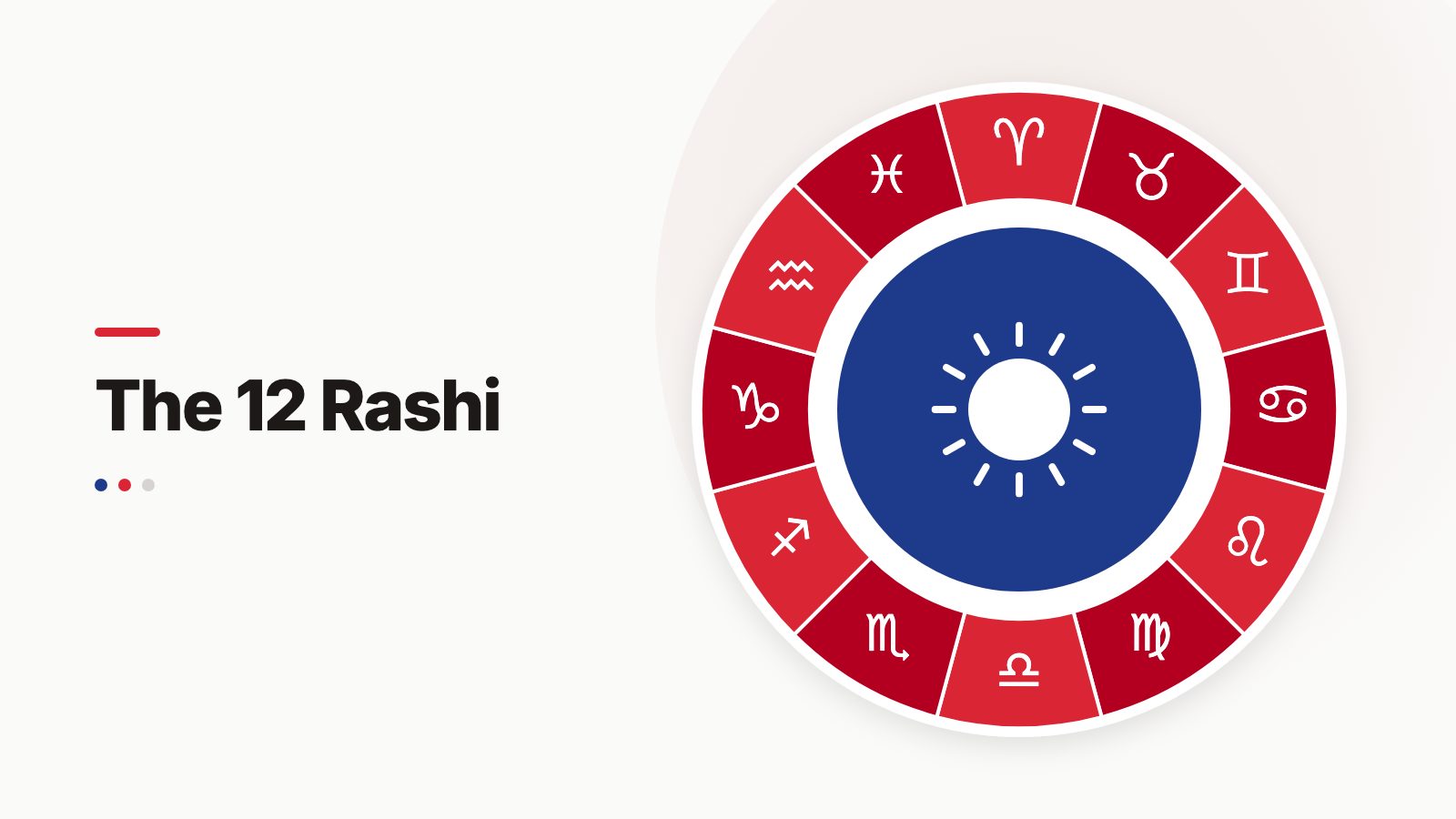
A Rashi is a zodiac sign in Vedic astrology. The sky along the Sun's apparent path is divided into twelve parts of 30 degrees each, and each part is one Rashi. The twelve Rashi, in order, are Mesh (Aries), Vrishabh (Taurus), Mithun (Gemini), Karkat (Cancer), Simha (Leo), Kanya (Virgo), Tula (Libra), Vrischik (Scorpio), Dhanu (Sagittarius), Makar (Capricorn), Kumbha (Aquarius) and Meen (Pisces). Nepali and Hindu horoscopes are read from these twelve signs.
Each Rashi has a ruling planet, an element and a set of traditional personality traits. In Nepali astrology the sign that matters most is your moon sign: the Rashi the Moon was in when you were born. Western horoscope columns use the Sun sign instead, so your Nepali Rashi and your Western sign are often different.
Below is a table of all twelve Rashi with their English names, symbols, ruling planets and elements, followed by the traits traditionally linked to each sign.
What are the 12 Rashi in order?
The twelve Rashi always run in the same order, from Mesh to Meen, and follow the twelve constellations of the sidereal (nirayan) zodiac. Each sign covers exactly 30 degrees. Each sign is ruled by one of the classical planets. The Sun and the Moon rule one sign each; Mars, Venus, Mercury, Jupiter and Saturn rule two signs each.
| # | Rashi (Nepali) | English name | Symbol | Ruling planet | Element |
|---|---|---|---|---|---|
| 1 | Mesh (मेष) | Aries | Ram | Mars (Mangal) | Fire |
| 2 | Vrishabh (वृष) | Taurus | Bull | Venus (Shukra) | Earth |
| 3 | Mithun (मिथुन) | Gemini | Twins | Mercury (Budha) | Air |
| 4 | Karkat (कर्कट) | Cancer | Crab | Moon (Chandra) | Water |
| 5 | Simha (सिंह) | Leo | Lion | Sun (Surya) | Fire |
| 6 | Kanya (कन्या) | Virgo | Maiden | Mercury (Budha) | Earth |
| 7 | Tula (तुला) | Libra | Scales | Venus (Shukra) | Air |
| 8 | Vrischik (वृश्चिक) | Scorpio | Scorpion | Mars (Mangal) | Water |
| 9 | Dhanu (धनु) | Sagittarius | Archer | Jupiter (Brihaspati) | Fire |
| 10 | Makar (मकर) | Capricorn | Sea-goat | Saturn (Shani) | Earth |
| 11 | Kumbha (कुम्भ) | Aquarius | Water-bearer | Saturn (Shani) | Air |
| 12 | Meen (मीन) | Pisces | Fish | Jupiter (Brihaspati) | Water |
The four elements repeat three times around the wheel in the order fire, earth, air, water. The fire signs are Mesh, Simha and Dhanu. The earth signs are Vrishabh, Kanya and Makar. The air signs are Mithun, Tula and Kumbha. The water signs are Karkat, Vrischik and Meen. Signs of the same element are said to have a similar broad temperament, and the ruling planet adds its own qualities on top.
To find your Rashi you need your birth date, birth time and birth place. The same details are used for your birth chart and for Kundali matching.
What traits are linked to each Rashi?
The traits of each Rashi come from its element and its ruling planet. They are traditional descriptions of general temperament. They are not fixed rules: a person's actual character depends on the whole birth chart, their upbringing and their own choices. The main traits of all twelve signs are listed below.
Mesh (Aries) and Vrishabh (Taurus)
Mesh is a fire sign ruled by Mars. It is described as bold and energetic, quick to start new things, competitive and keen to lead. Its weak point is impatience. Vrishabh is an earth sign ruled by Venus. It is described as steady and patient, fond of comfort and good food, loyal, and focused on material security. Once it has taken a position it can be stubborn.
Mithun (Gemini) and Karkat (Cancer)
Mithun is an air sign ruled by Mercury. It is described as curious, talkative, quick-witted and adaptable. It likes variety, and this can turn into restlessness. Karkat is a water sign ruled by the Moon. It is described as emotional and caring, strongly attached to home and family, sensitive to moods, and protective of the people it loves.
Simha (Leo) and Kanya (Virgo)
Simha is a fire sign ruled by the Sun. It is described as confident and warm, drawn to leadership and recognition, generous, and also proud. Kanya is an earth sign ruled by Mercury. It is described as analytical, practical and careful with details. It values service, health and order, and can be too critical of itself and others.
Tula (Libra) and Vrischik (Scorpio)
Tula is an air sign ruled by Venus. It looks for balance, harmony and fairness and is good with people, but it can find decisions hard. Vrischik is a water sign ruled by Mars. It is described as intense, passionate and determined, with strong willpower and a private nature. It feels things strongly, is very loyal, and is slow to forget a wrong.
Dhanu (Sagittarius) and Makar (Capricorn)
Dhanu is a fire sign ruled by Jupiter. It is described as optimistic and philosophical, fond of freedom, and drawn to travel, study and big ideas. Makar is an earth sign ruled by Saturn. It is described as disciplined, ambitious and patient. It builds success step by step through hard work and takes its responsibilities seriously.
Kumbha (Aquarius) and Meen (Pisces)
Kumbha is an air sign, also ruled by Saturn. It is described as independent, original and concerned with the welfare of others. It gives more weight to ideas and community than to convention. Meen is a water sign ruled by Jupiter. It is described as kind, imaginative and intuitive, emotionally sensitive, and drawn to art, spiritual practice and helping others. Its weak point is not setting clear limits.
How is your Rashi used in daily astrology?
In Nepal, your moon Rashi is the sign you look up in daily, weekly and monthly horoscopes in newspapers and apps. These forecasts are based on how the planets currently move through your Rashi and the signs around it, which is read as a good or difficult time for the days ahead.
The Rashi is also used in more detailed readings. Together with the 27 Nakshatras it gives the Moon's exact position at birth, which is used for the naming ceremony and for detailed predictions. For marriage, the Rashi of both partners goes into Ashtakoot 36-gun matching, and the position of Mars decides Manglik Dosha. For what a daily horoscope covers, read what Rashifal is. Katigate's daily Rashifal is generated automatically for each of the twelve moon signs.
Using the traits list fairly
These traits describe traditional astrological associations. They cannot establish how a person will behave, whether a couple is compatible, or which job someone should choose. If you do not know your birth Moon sign, do not treat a sign guessed from a modern given name as confirmed.
More tools on Katigate
Frequently Asked Questions
Is Rashi based on the Sun sign or the Moon sign?
In Nepali and Indian Vedic astrology, your Rashi usually means your moon sign: the sign the Moon was in when you were born. Western horoscope columns use the Sun sign, so the same person can have a different sign in each system. Vedic readings rely mainly on the moon Rashi.
How do I find out my Rashi?
Your Rashi depends on your exact birth date, time and place, because these fix where the Moon was in the zodiac. The simplest way is to make a birth chart from these details, with an astrologer or an app. Many people in Nepal also know their Rashi from the first syllable of their traditional birth name, since that syllable is chosen from the Moon's position at birth.
Do two people with the same Rashi have the same personality?
No. Sharing a Rashi means sharing the broad traits tied to that sign's element and ruling planet. A full chart also includes the Sun, the ascendant (lagna), the Nakshatra and the positions of all the planets, so two people with the same Rashi can differ a lot in personality, in the timing of events and in how their lives go.
Which Rashi are most compatible for marriage?
Vedic astrology does not name fixed best pairs. It checks compatibility through Ashtakoot Kundali matching, which compares both charts on eight factors for a total of up to 36 points. Matching elements and friendly ruling planets help, but the gun-milan score, doshas and the position of Mars give a far more reliable answer than the sign alone.